
Choosing the best Tube End Forming Machines in 2026 is not a brand-ranking exercise. It is a production decision. A machine that forms a clean flare in thin stainless steel may struggle with thicker alloy tube or frequent part changes. The right choice depends on tube diameter, wall thickness, material, end-form geometry, production volume, and the operator’s skill.
Automation is part of the wider manufacturing picture. The International Federation of Robotics reported 542,000 industrial robot installations worldwide in 2023, with 4.28 million robots operating in factories. That report does not measure tube end forming machines specifically. It does, however, show how extensively manufacturers are investing in automated production. A useful reminder, not a buying verdict.
“Where there is no standard, there can be no kaizen,” wrote Taiichi Ohno, a key figure in the Toyota Production System. His point applies on the shop floor: repeatable setups and clear process standards matter as much as headline speed. This guide compares machine types and selection criteria, including tooling changes, control systems, guarding, service support, and the consistency of finished ends. Ask suppliers for sample parts and cycle-time evidence using your actual tube. A polished demonstration can hide a difficult changeover. And no single machine is best for every shop. Some trade-offs only become clear after installation. That deserves a closer look.
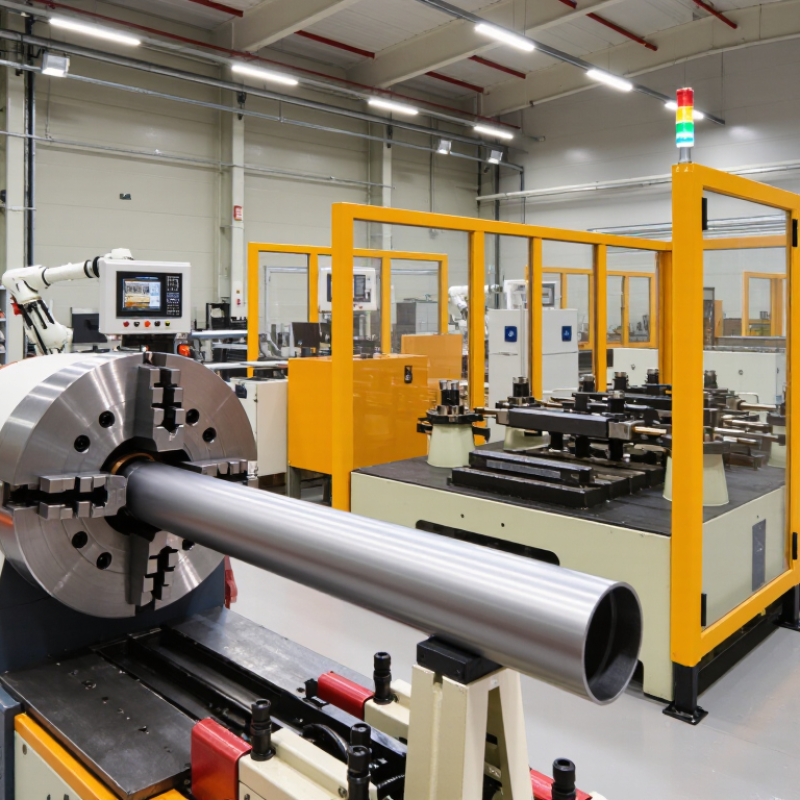
A tube end forming machine reshapes the open end of a tube so it can connect, seal, or fit another part. The operator loads the tube against a stop and clamps it firmly. A forming tool then moves into or around the tube end. Depending on the tooling, it can create a flare, bead, groove, or reduced section. Some machines use axial force; others rotate the tube or tool. The choice depends on tube material, wall thickness, and the geometry required.
The sequence sounds simple. Small details matter. Poor alignment can leave an uneven lip, while excessive force may wrinkle or split thin-walled tubing. Operators usually verify the first parts with gauges, then adjust tool position, pressure, and cycle settings. Sensors can help track those settings, but they do not replace inspection. Deloitte’s 2024 Smart Manufacturing Survey, conducted with MAPI, found that 86% of manufacturing executives viewed smart manufacturing solutions as important drivers of competitiveness over the following five years. That figure describes manufacturers’ expectations, not tube-forming performance specifically. Still, it highlights why process monitoring is gaining attention. A practical setup records repeatable parameters, while leaving room for the occasional stubborn tube.
Tube end forming machines reshape the end of a tube using matched tooling. The right machine depends on the material, wall thickness, required geometry, tolerances, and production volume—not on one forming method alone.
Illustrative geometry example: each percentage is calculated from a 25.4 mm starting tube outside diameter. Finished feature diameters are example values, not industry standards or machine-performance data.
Tube-end forming combines several distinct operations. Flaring opens a tube mouth to seat a fitting; swaging reduces its diameter, while beading creates a raised retaining lip. Expansion and reduction alter the end section without changing the full tube. Small changes matter. A few millimeters of flare depth can affect assembly fit, and thin-wall stainless steel may wrinkle under excessive axial pressure. Tooling must match material, wall thickness, and target geometry. Mandrels support the bore; segmented dies control the outside profile. Springback still needs checking on real parts.
Machine selection depends on the process sequence, not just advertised speed. The International Federation of Robotics reported 541,302 industrial robots installed worldwide in 2023, in its World Robotics 2024 report. That signals wider automation, but does not prove every tube-end line needs a robot. Deloitte and The Manufacturing Institute estimated that U.S. manufacturing could need up to 3.8 million workers by 2033, with 1.9 million roles potentially unfilled. Those figures are broad workforce estimates, not tube-forming forecasts. They do make repeatable setup and safe, ergonomic loading worth evaluating. A caveat: faster cycles can hide poor alignment; inspect sample ends under production conditions.
Tube end forming machines shape a tube’s end without replacing the full tube. Expanding and flaring machines enlarge openings for hoses, fittings, or slip joints. They suit plumbing, HVAC, and automotive assemblies where a consistent connection matters. Beading machines form a raised ring that helps retain a hose or clamp. The bead must sit in the right place; a few millimeters can affect assembly.
Rotary swaging and end-reducing machines compress tube ends to create smaller spigots for insertion into another component. They are useful for frames, exhaust parts, and furniture. CNC multi-station machines combine operations such as forming, trimming, and flaring, helping repeat complex shapes in production runs. But more automation is not always better. For short runs, setup time can outweigh the saved handling.
Tips: Check tube material, wall thickness, diameter, and required end profile before choosing a machine. Test samples under realistic conditions. Inspect for wrinkles, cracks, and uneven edges. Fit matters. A well-formed end still needs a matching tool and a controlled feed rate. Some specifications look clear on paper, yet the first trial may reveal a detail that needs revisiting.
In 2026, compare machines against the parts you actually produce, not just the largest capacity listed in a specification sheet. Check tube diameter, wall thickness, material, and end forms such as flares, beads, or reductions. Request a trial using your own tube stock. A clean sample matters, but so does consistent quality across a full shift.
Look closely at forming force, station layout, and how quickly operators can change tooling. Ask how the machine handles short production runs and frequent setup changes. Review control settings, guarding, maintenance access, and the availability of technical support. If possible, measure several finished parts and compare their dimensions. No machine wins every job. A high-speed unit may be a poor fit when changeovers dominate the workday.
Tips: Bring a few representative tubes to a supplier demonstration. Note setup time, noise, and how easily an operator can repeat a successful cycle. Check the floor space and power requirements before comparing prices. Small details matter. And be cautious: a polished demo may not reflect your everyday production conditions.
Choosing a tube end forming machine starts with the parts, not the catalogue. List the tube materials, outside diameters, wall thicknesses, and end profiles you actually produce. A setup for thin-wall stainless steel may not suit thicker structural tubing. Bring sample parts and drawings to a machine trial. Check for ovality, surface marks, and consistent dimensions after repeated cycles. Small defects matter.
Match capacity to real production needs. A high cycle rate is useful only if loading, tooling changes, and inspection keep pace. Ask how long a typical changeover takes, and whether operators can adjust recipes without confusing controls. Simple controls help. Also consider floor space, power requirements, guarding, and access for routine maintenance. These details can be easy to overlook.
Tooling flexibility may matter more than maximum force if your shop handles varied profiles. Confirm which forming operations the machine supports, and ask how tooling is stored and aligned. Verify repeatability across a full production run, not just a few demonstration pieces. Service response and operator training deserve equal attention; a capable machine can still cause delays when support is hard to reach. The trade-off is real: more automation may reduce handling, but it can add setup complexity. Decide using your expected workload, not an optimistic forecast.
| Machine Type | Typical End-Forming Operations | Best Suited For | Key Advantages | Important Trade-Offs | Key Selection Checks |
|---|---|---|---|---|---|
| Hydraulic single-station end former | Expansion, reduction, flaring, beading, and other operations supported by the installed tooling. | Low-to-medium production volumes, larger forming forces, and job shops making varied parts. | High forming force; flexible tooling options; suitable for many steel and stainless-steel applications when correctly sized. | Hydraulic systems require fluid and filter maintenance. Cycle time, noise, and energy use depend on the machine and operating conditions. | Confirm force and stroke requirements, tube diameter and wall thickness, tooling availability, guarding, and setup time. |
| Servo-electric CNC end former | Programmable axial forming, including expansion, reduction, and multi-step profiles with compatible tooling. | Repeat production, frequent changeovers, and applications where controlled motion and process repeatability matter. | Programmable motion and adjustable forming sequences; can provide consistent cycle control and reduce dependence on manual adjustment. | Initial cost and control-system complexity can be higher. Actual accuracy and throughput depend on the machine, tooling, material, and process setup. | Review axis count, recipe storage, changeover method, service support, safety functions, and whether the controls suit the required process. |
| Rotary swaging machine | Radial reduction, tapering, pointing, and forming stepped or reduced tube ends using dies. | Parts requiring a reduced or tapered end, especially when a smooth transition and repeatable die-based forming are needed. | Forms the tube radially around its circumference; can produce reduced ends without relying on a simple axial push alone. | Part geometry and material determine achievable reduction. Die design, tube support, and process parameters are critical to avoid defects. | Check maximum tube size, material and wall-thickness limits, reduction ratio, die life, lubrication needs, and finished-end tolerances. |
| Roll-type end former or beading machine | Rolling beads, grooves, flares, and other formed profiles that can be produced with the machine’s roll tooling. | Repeatable profiles on compatible tube materials and geometries, including applications that benefit from a rolled feature. | Forms profiles through rotating rolls; can be suitable for continuous or repeated feature production when the part design allows it. | Not every end shape can be produced by rolling. Tool access, tube support, and profile geometry limit applicability. | Verify roll access, profile dimensions, tube-end support, material springback, and whether the feature can be formed without distortion. |
| Multi-station CNC end-forming system | Sequential operations such as cutting or facing, chamfering, expanding, reducing, and forming, depending on station configuration. | High-volume production with a stable part family and several repeatable end-forming steps. | Combines compatible process steps in a planned sequence; automation can reduce handling between operations. | Higher investment and more complex setup. Dedicated tooling and changeover effort may be less attractive for frequently changing, low-volume work. | Assess required operations, station layout, loading and unloading, tooling-change time, part traceability, and integration with upstream or downstream equipment. |
| Manual or semi-automatic end former | Basic expansion, reduction, flaring, or other operations using operator-loaded tooling. | Prototypes, maintenance work, small batches, and production with many part changes. | Generally straightforward to operate and can be practical when automation is not justified by production volume. | Output and consistency depend more heavily on operator method and setup. It may not meet high-volume cycle-time requirements. | Check operator safety, repeatability requirements, adjustment features, available tooling, and realistic output per shift. |
| Selection note: There is no single best machine for every tube. Confirm the actual tube material, outside diameter, wall thickness, end geometry, production volume, tolerances, and available tooling with the machine supplier. Rated capacity and achievable results vary by machine configuration and process conditions. | |||||