


What Is Ion Exchange Resin and How Does It Work?
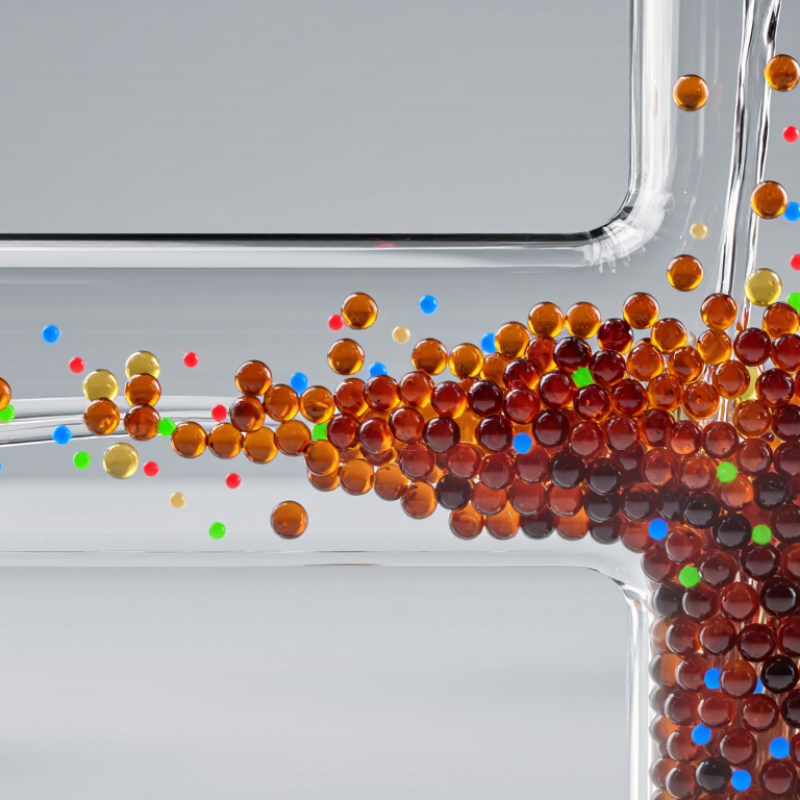
Ion Exchange Resin is a porous, bead-shaped material that removes selected dissolved ions from water. Inside a treatment column, thousands of amber or dark beads create a large contact area. Their fixed chemical groups attract ions with an opposite charge. As water flows past, unwanted ions attach to the resin, while other ions are released into the water. In a softener, for example, resin commonly captures calcium and magnesium and releases sodium. The exact exchange depends on the resin type and the water’s chemistry. The beads are small. Their effect can be significant.
This process is useful in water softening, demineralization, and some industrial purification systems. Cation resins exchange positively charged ions; anion resins exchange negatively charged ones. A mixed bed combines both types to remove more dissolved minerals. Yet resin is not a universal filter. Suspended particles, oils, and certain organic compounds may require separate treatment. Performance also changes with flow rate, competing ions, temperature, and resin condition. That matters. When exchange sites are used up, suitable resins can often be regenerated with a chemical solution, though the method depends on the application. Regeneration does not make every system efficient or maintenance-free. Operators need to monitor water quality and follow the equipment manufacturer’s guidance. The basic idea is simple, but real systems deserve careful attention. Even a clear-looking sample can contain dissolved ions that only testing will reveal.
What Ion Exchange Resin Is
Ion exchange resin is a porous, bead-shaped material made from a stable polymer. Its surface and internal structure carry chemical groups that hold charged particles, called ions. When a liquid flows around the beads, certain dissolved ions can trade places with ions already attached to the resin. The resin stays solid. The ions move.
Different resins are designed for different exchanges. Cation resins handle positively charged ions, while anion resins handle negatively charged ones. In water treatment, for example, a softening resin can capture calcium and magnesium ions and release other ions in their place. This is not ordinary straining: the target ions are dissolved, so a mesh cannot simply catch them. The exact result depends on the resin, water chemistry, and operating conditions. It is easy to oversimplify that part.
Tips: Check the liquid’s pH, ion content, and flow rate before choosing a resin. Beads that look alike may perform differently. A resin also has limited capacity; once its exchange sites are occupied, performance can decline. Monitor the treated liquid rather than relying on appearance alone.
What Is Ion Exchange Resin and How Does It Work? - What Ion Exchange Resin Is
| Dimension | Description | How It Works or Typical Example |
|---|---|---|
| What it is | A water-insoluble material containing fixed, electrically charged sites that can exchange mobile ions with a surrounding solution. | Most water-treatment resins are small, porous polymer beads with functional groups attached to their structure. |
| Resin structure | The polymer matrix provides a stable framework, while functional groups provide the sites that attract ions. | The matrix is commonly made from cross-linked polymers; water and dissolved ions move through pores in the bead. |
| Basic exchange process | An ion in the water replaces a mobile counterion associated with a fixed charged site on the resin. | For example, a cation resin in sodium form can exchange sodium ions for calcium ions in water. |
| Charge balance | Exchange maintains electrical neutrality: the resin releases an equivalent amount of charge as it takes up ions. | One calcium ion with a 2+ charge generally displaces two sodium ions with 1+ charges. |
| Cation-exchange resin | Contains negatively charged functional sites and exchanges positively charged ions (cations). | Common targets include calcium, magnesium, and other dissolved cations. Hydrogen-form cation resins can exchange hydrogen ions for cations. |
| Anion-exchange resin | Contains positively charged functional sites and exchanges negatively charged ions (anions). | Depending on the resin and water chemistry, targets can include chloride, nitrate, or sulfate ions. |
| Strong-acid and strong-base types | These resins have functional groups that remain ionized across a broad pH range. | Strong-acid cation resins commonly use sulfonic acid groups; strong-base anion resins commonly use quaternary ammonium groups. |
| Weak-acid and weak-base types | Their ionization and exchange behavior depend more strongly on solution pH. | Weak-acid cation resins commonly contain carboxylic groups; weak-base anion resins commonly contain amine groups. |
| Selectivity | Resins may prefer some ions over others, but the degree of preference depends on resin chemistry and solution conditions. | Ion charge, concentration, competing ions, and the resin’s functional groups can all affect which ions are taken up first. |
| Capacity and exhaustion | Exchange capacity describes how much ionic charge a quantity of resin can hold under specified conditions. | As exchange sites fill, the resin approaches exhaustion and its ability to remove the target ions declines. |
| Regeneration | A regenerant solution restores the resin to a chosen ionic form by displacing ions captured during service. | The regenerant depends on the process and resin form; regeneration produces a waste stream containing displaced ions and excess regenerant. |
| Common applications | Ion exchange is used to selectively remove, recover, or change the ionic composition of liquids. | Applications include water softening, demineralization, and treatment or recovery of selected dissolved ions. |