
An Rfid Wristband is a wearable identification device that uses radio waves to exchange data with a nearby reader. It usually combines an RFID chip, a small antenna, and a fabric, silicone, or plastic band. Passive wristbands receive power from the reader’s signal, while active versions use a battery for longer range and memory. The technology does not require direct contact. Often, it does not require a clear line of sight.
In a venue, a guest may tap or pass the wristband near a reader at an entrance. The reader captures the tag’s identifier and sends it to software, which can confirm access, record attendance, or connect approved services. This process takes only seconds. The visible result may be simple, but the backend matters. Accurate encoding, reader placement, database security, and staff training influence reliability.
Industry research shows why adoption continues. IDTechEx’s RFID Forecasts, Players and Opportunities 2024–2034 report identifies retail, logistics, healthcare, and events as major growth areas. GS1 standards also emphasize consistent identification and data exchange across supply chains. The RFID market remains substantial, with billions of tags produced annually, according to industry forecasts from IDTechEx and RAIN RFID research. However, a wristband is not a perfect solution. Metal surfaces, liquids, crowded entrances, and damaged antennas can reduce performance. Privacy design matters too. Organizations should explain what data is collected, limit retention, and test the system in real conditions. It is not magic. The details matter.
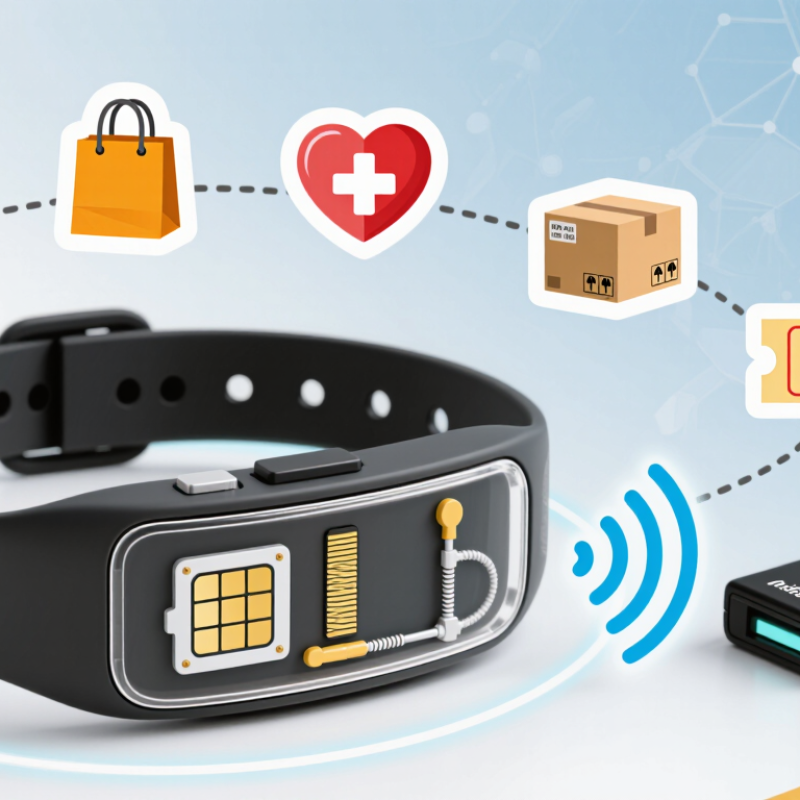
An RFID wristband is a wearable identification device that communicates through radio waves. Its main component is the RFID inlay, which contains a tiny integrated circuit and antenna. The circuit stores a unique identification number, while the antenna receives and returns radio signals. Most wristbands are passive, so they use energy from a nearby reader instead of a battery. Some specialized versions include batteries for longer reading distances.
The inlay is sealed inside a flexible strap, often made from fabric, silicone, or plastic. This outer material protects the electronics from sweat, light rain, and repeated bending. A reader sends a signal when the wristband enters its range. The antenna captures that energy, and the chip sends back its stored data. Software then connects the identifier with approved information, such as an entry record or payment account. In practice, the reader, software, and wristband must work together. A reliable chip cannot fix poor reader placement.
Tips: Test wristbands on real wrists, not only on a desk. Metal objects, crowded entrances, and body position can affect reading performance. Keep the antenna area flat when possible. Also, collect only necessary data. It is easy to focus on speed and overlook privacy, comfort, or accidental scans. That mistake deserves another review.
An RFID wristband is a small wireless identifier worn on the wrist. Its key parts are an RFID chip and antenna. Most event wristbands use passive RFID, so they contain no battery. A 2023 RAIN Alliance industry report recorded 52.8 billion RAIN tags sold worldwide, showing how widely this technology is used.
Communication begins when a reader emits radio waves. The wristband antenna captures a small amount of energy from that field. The chip then wakes and sends stored information by changing the reflected signal. This process is called backscatter. The reader detects these tiny changes, decodes the response, and passes the data to a connected system. The wristband does not actively broadcast like a mobile phone. It responds only when the reader provides enough energy.
Distance is not guaranteed. Metal barriers, dense crowds, wet clothing, and poor antenna alignment can weaken the exchange. A reader may detect a wristband at several meters in open conditions, but real venues often produce shorter ranges. Testing should include movement, overlapping wristbands, and different wrist positions. This is where simple diagrams become misleading. In my view, RFID explanations sometimes sound too perfect; field performance remains sensitive to installation quality. ISO/IEC 18000-63 and EPC Gen2 specifications provide the technical foundation, but practical results still require careful tuning and repeated measurement.
| Data Dimension | Typical or Factual Information | How It Works in Practice |
|---|---|---|
| Basic Definition | An RFID wristband is a wearable identification device containing an RFID integrated circuit and antenna. | The wristband stores identifying information that can be read wirelessly without direct contact or line-of-sight scanning. |
| Main Components | RFID chip, antenna, protective wristband material, and sometimes a printed or encoded identifier. | The chip processes commands and stores data, while the antenna receives radio energy and exchanges signals with the reader. |
| Common RFID Type | Many wearable wristbands use passive high-frequency RFID operating at 13.56 MHz. | The exact operating frequency depends on the application and the applicable technical standard. Some systems use other RFID frequency ranges. |
| Power Source | Passive RFID wristbands normally have no battery. | The reader generates a radio-frequency field. The wristband antenna captures part of this energy and the chip uses it for a short communication session. |
| Reader Signal | The reader transmits a carrier signal and may send commands or data through changes in that signal. | The wristband detects the field, synchronizes with the reader, and responds only when it receives a compatible request. |
| Wristband Response | The RFID chip usually communicates by changing the electrical load on its antenna. | These controlled changes, known as load modulation, alter the reader’s received signal. The reader detects and decodes the changes as digital data. |
| Information Commonly Stored | A unique identifier, access credential, event entitlement, or a small amount of application data. | Many systems store only an identifier and keep detailed user or transaction information in a connected database rather than on the wristband. |
| Typical Reading Distance | Short-range passive wristbands commonly operate from a few centimeters to several tens of centimeters. | Actual distance depends on frequency, antenna size, reader power, wristband orientation, surrounding materials, and the specific RFID system. |
| Communication Sequence | Field generation, tag detection, command exchange, identification, data transfer, and session completion. | The reader creates a field, detects one or more wristbands, selects a tag when necessary, sends a command, and receives the wristband response. |
| Multiple Wristbands | RFID systems can use anti-collision procedures when more than one tag is within the reading area. | The reader organizes responses so that individual wristbands can be identified without requiring every tag to transmit at exactly the same time. |
| Line of Sight | RFID generally does not require a direct visual line of sight. | A wristband may be read through non-metallic materials, although distance and reliability can be reduced by water, metal, dense materials, or poor tag orientation. |
| Read and Write Capability | Some RFID wristbands are read-only or identifier-focused, while others support memory writing. | Writing requires a compatible reader, suitable permissions, and a chip designed to accept data updates. |
| Security Considerations | A unique identifier by itself is not the same as strong authentication or encryption. | Applications requiring greater protection may use cryptographic authentication, encrypted communication, access controls, and server-side verification. |
| Factors Affecting Reliability | Distance, antenna alignment, reader placement, nearby metal or liquids, electromagnetic interference, and wristband condition. | Keeping the wristband within the intended reading zone and positioning the reader correctly generally improves communication consistency. |
| Common Uses | Access control, attendance tracking, event entry, cashless account identification, lockers, and visitor management. | The reader captures the wristband identifier and sends it to an application that determines whether to grant access or record an action. |
| Battery-Powered Variants | Some wearable RFID-related devices may include a battery, but a standard passive RFID wristband does not require one. | Battery-assisted designs can support additional functions or greater communication range, depending on their architecture. |
| Reader Output | The reader typically produces an identifier, read result, timestamp, and sometimes signal or error information. | Software uses this information to validate a credential, update a record, trigger an action, or display a confirmation. |
Note: Communication range, frequency, memory capacity, security features, and supported commands vary by RFID technology, chip design, reader configuration, and installation environment.
An RFID wristband scan begins when a reader sends radio energy through its antenna. The wristband’s tiny tag captures enough energy to respond. It returns a stored identification number, not a full personal profile. The reader then transfers that number to access-control or ticketing software. This exchange usually takes less than a second.
The process follows the radio interface defined by ISO/IEC 18000-63. Distance, antenna position, and wristband orientation still matter. A 2024 industry report from the RAIN RFID Alliance recorded more than 50 billion RAIN RFID tags sold worldwide in the previous year. That scale reflects broad adoption, but it does not guarantee every scan will succeed. Metal barriers, crowded entrances, wet materials, and overlapping readers can weaken performance. Sometimes, the reader beeps late.
During a practical scan, staff may see a green confirmation light while the system records time, location, and event status. The tag normally contains only a unique identifier. Secure software decides what that identifier means. This separation supports better privacy control. However, a poorly configured system can still expose unnecessary movement data. Operators should test wristbands on real users, not only on a desk. They should also review failed scans, because a smooth demonstration can hide awkward wrist angles and queue pressure. Research from the U.S. National Institute of Standards and Technology emphasizes that reliable identification depends on system design, testing, and controlled data handling.
RFID wristbands are most visible where many people need quick, controlled access. A passive wristband contains a small RFID chip and antenna. When it enters a reader’s field, the chip reflects a stored identification number. The reader then connects that number to an approved record. No battery is usually required. No GPS is involved.
Event venues commonly use RFID wristbands for admission, cashless purchasing, and age-based access control. A scan can open a gate in seconds, reduce paper ticket checks, and show attendance patterns. MarketsandMarkets’ 2024 RFID report valued the global RFID market at approximately 14 billion dollars in 2023. It projects strong growth through 2028, supported by retail, healthcare, logistics, and entertainment applications. That growth reflects practical demand, not just technical enthusiasm.
Hospitals may use wristbands to identify patients, locate equipment, or record staff access. Hotels, water parks, and fitness facilities can connect wristbands with lockers, rooms, or prepaid services. In practice, placement matters. Wet skin, metal surfaces, and crowded entry points can reduce reading reliability. The system is not magic. Poor data protection can also create unnecessary privacy risks, so venues should collect only essential information and explain retention periods clearly. The RAIN Alliance reported tens of billions of RFID tags shipped globally in recent annual industry data, yet wristband projects still need careful testing. A short pilot often reveals more than a polished demonstration.
RFID wristbands contain a small tag with an antenna and, in many cases, a memory chip. When the wristband enters a reader’s electromagnetic field, the tag transmits its stored identification data. The reader then sends that data to an access-control, ticketing, payment, or visitor-management system.
Read distance varies with antenna size, reader power, tag design, and the surrounding environment. The values below show representative operating distances rather than guaranteed limits.
RFID wristbands are commonly used for event admission, hotel and resort access, healthcare identification, amusement venues, fitness facilities, cashless transactions, and location-based visitor services. HF and NFC wristbands are generally used for close-range taps, while UHF systems can support longer-range, hands-free identification.
An RFID wristband contains a tiny chip and antenna. Readers send radio waves, then capture the band’s identifier without direct contact. The system can support event entry, cashless payments, hospital tracking, and visitor management. RAIN Alliance reported over 50 billion RAIN RFID inlays shipped globally in 2023. However, wristbands represented only a portion of that volume.
The benefits are practical. Staff can reduce queues, locate assets, and record movement automatically. A wristband can also improve accessibility when users do not need to show a ticket repeatedly. Yet performance is not perfect. Metal surfaces, dense crowds, wet skin, and poor reader placement can weaken detection. Passive tags also have limited range and usually store little information. They identify a record, not the person itself. That distinction is often misunderstood. The 2024 RFID Forecasts, Players and Opportunities report from IDTechEx describes strong market growth, but adoption does not remove implementation risks.
Privacy concerns deserve direct attention. A wristband may reveal attendance, location, or purchase patterns when linked with an account. The Information Commissioner’s Office recommends data minimisation, defined retention periods, access controls, and privacy impact assessments for tracking technologies. Operators should offer a non-RFID alternative where practical. They should also explain deletion procedures. “Convenient” is not automatically private. A rushed deployment can create more data than the service actually needs.