China Top 10 CPU Cooling Fan Manufacturers?
China’s CPU cooling fan industry combines large-scale manufacturing with increasingly precise thermal engineering. This introduction examines ten notable manufacturers, comparing their design capabilities, production experience, quality controls, and international market reach. The focus remains practical: airflow, static pressure, noise levels, bearing durability, materials, and after-sales reliability.
Noctua co-founder Roland Mossig has emphasized, “A fan is not a standalone product; it is part of a system.” This principle matters when evaluating every Cpu Cooling Fan on this list. A fan may spin quietly in a laboratory, yet perform poorly inside a dusty gaming case with restricted ventilation. Real results depend on blade geometry, motor control, radiator resistance, mounting space, and operating temperature.
Details matter.
Many Chinese manufacturers offer competitive pricing, flexible OEM services, and fast customization. However, low cost alone cannot prove dependable performance. Some product pages provide impressive airflow figures without explaining testing conditions. That weakness deserves attention. Buyers should request acoustic data, lifespan ratings, bearing specifications, and sample testing before making a decision.
This overview also considers factory consistency, certifications, engineering support, and export experience. Those factors often reveal more than attractive packaging. The leading companies are not identical. Some specialize in gaming systems, while others serve servers, industrial equipment, or branded computer makers. Their strengths can change as technology and customer expectations evolve. Therefore, this ranking should be treated as a researched starting point, not an unquestionable verdict.
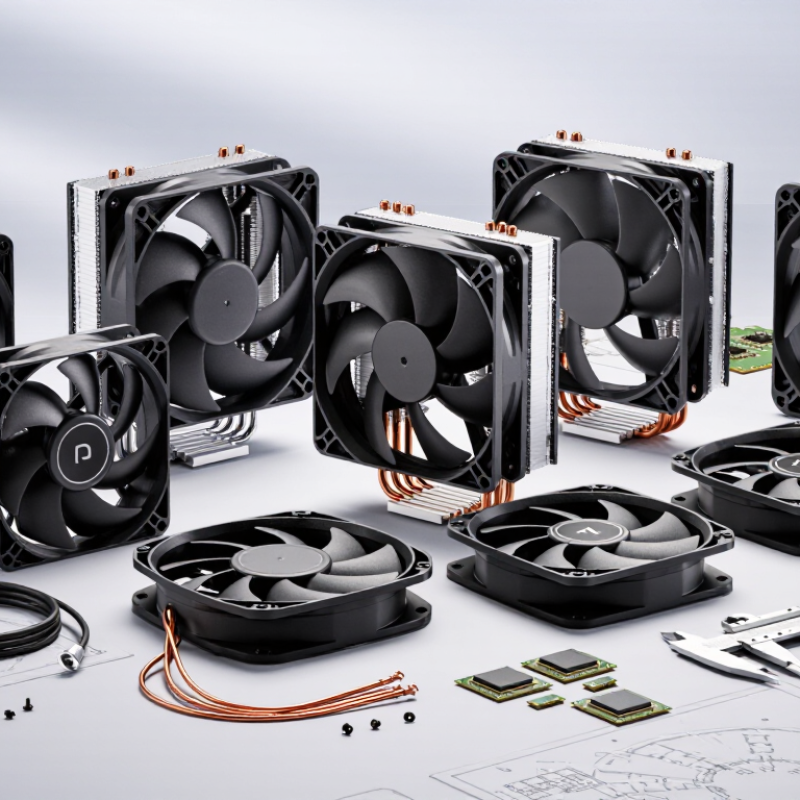
How China’s Top 10 CPU Cooling Fan Manufacturers Are Ranked
China Top 10 CPU Cooling Fan Manufacturers?
Ranking China’s top 10 CPU cooling fan manufacturers requires more than checking factory output. A reliable evaluation combines thermal performance, acoustic control, production consistency, and technical support. Independent testing should use the same heatsink, processor, room temperature, and fan speed. A 30-minute processor load can reveal temperature stability, while a sound meter records changes at 50% and 100% PWM speed.
Manufacturers earn stronger positions when their fans maintain stable airflow through dense fin stacks. Bearing life also matters. A fan may sound quiet on day one but develop vibration after extended operation. Quality reviews should inspect motor balance, frame rigidity, cable protection, and automatic speed response. Factory audits, sample consistency, warranty handling, and documented testing procedures add further credibility. Not every low-cost model is weak.
The ranking should also consider practical value for system builders. A slightly slower fan may be preferable if it produces less resonance inside a compact case. Export experience and compliance documentation can support reliability, but paperwork cannot replace physical testing. Results may change between laboratories. That is the uncomfortable part. Temperature readings are affected by mounting pressure, thermal paste, and room airflow. For this reason, the top ten should be treated as a measured comparison, not a permanent judgment. A manufacturer’s position deserves review whenever new motor designs, bearings, or control systems reach production.
China Top 10 CPU Cooling Fan Manufacturers: Ranking Framework
The chart presents a transparent, company-neutral scoring framework for ranking CPU cooling fan manufacturers in China. The evaluation emphasizes measurable areas commonly used in industrial sourcing: thermal performance, product reliability, manufacturing capacity, quality management, and export support. The percentages represent the weighting of each criterion, not individual company results.
Profiles of China’s Leading CPU Cooling Fan Manufacturers
China’s leading CPU cooling fan manufacturers usually combine high-volume production with flexible engineering services. Their profiles often include OEM and ODM capabilities, automated blade balancing, injection molding, and in-house motor assembly. Many supply 120 mm and 140 mm fans for desktop systems, servers, and compact workstations. Their products commonly support PWM control, fluid dynamic bearings, and vibration-reducing rubber mounts.
A reliable manufacturer should provide airflow curves, noise measurements, bearing-life estimates, and thermal test records. Look for clear data at different fan speeds, not one impressive laboratory figure. Experienced suppliers can adjust blade geometry, frame thickness, cable length, and connector design. They should also explain quality checks, including rotor balance, startup voltage, endurance testing, and packaging inspections. However, a polished profile is not proof of stable production. Factory visits, sample testing, and production audits still matter.
Tips: Request three samples from different batches. Measure noise beside the heat sink, not across an empty desk. Check whether the fan starts smoothly at low PWM settings. Ask for test conditions and raw data. A low price may hide weaker bearings or inconsistent motor control. That lesson is easy to forget. Also, cooling performance depends on the whole system, including case airflow, dust buildup, and mounting pressure. Manufacturers with responsive technical teams are often more useful than suppliers offering the longest catalog.
Comparison of Products, Performance, and Market Applications
China’s top ten CPU cooling fan manufacturers differ more in engineering choices than in appearance. Their portfolios usually include axial fans for desktop towers, compact blowers for thin devices, and high-static-pressure models for dense heatsinks. During evaluation, compare bearing design, blade geometry, speed range, noise output, and rated service life. A quiet fan is not always the best fan.
Performance should be measured under the same conditions. Use identical heatsinks, thermal loads, room temperatures, and mounting positions. Check temperature after the system reaches stability, not after a quick startup. PWM control can reduce noise during light workloads, while higher airflow helps sustained rendering or gaming. However, published airflow figures may use different test methods. Direct comparison can therefore be imperfect.
Market application changes the buying decision. Office computers may prioritize low noise and long operating life. Gaming systems often need stronger airflow and addressable lighting options. Industrial controllers require dust resistance, stable rotation, and reliable operation across wider temperatures. Embedded equipment may favor compact dimensions over peak cooling capacity. In field testing, cable length and connector quality also matter. Small installation details can delay production.
Leading manufacturers often support customization, sample testing, and bulk quality inspection. Ask for acoustic data, vibration results, and failure-rate records. Certifications and traceable inspection reports add confidence. Still, no specification replaces testing inside the target chassis. Some models performed well in open benches but weakened after filters and restricted vents were added. That limitation deserves honest attention.
How to Choose a Reliable Chinese CPU Cooling Fan Manufacturer
How to Choose a Reliable Chinese CPU Cooling Fan Manufacturer
Choosing among China’s top CPU cooling fan manufacturers requires more than comparing online prices. Request production samples, not only catalog photographs. Check the fan frame for molding marks, loose edges, and uneven screw holes. These small defects can cause vibration after installation. Measure airflow, static pressure, noise, and startup performance under the same test conditions. Ask whether the factory uses calibrated equipment and keeps test records.
A dependable manufacturer explains its motor design, bearing type, blade balance, and PWM control clearly. It should provide material specifications, inspection standards, and traceable batch numbers. Visit the facility when possible. Observe incoming-material checks, automated winding, final assembly, and aging tests. A clean line does not prove everything. However, missing records deserve attention. I still find this step easy to underestimate.
Discuss tooling ownership, minimum order quantities, packaging strength, and replacement procedures before signing an agreement. Confirm how the supplier handles failed samples and delayed shipments. Ask for a written quality agreement with measurable limits for noise, speed, and failure rates. Independent laboratory reports can support factory claims, but they should match the actual model. A polished website proves little. Consistent communication matters more. If engineers answer technical questions quickly, problems may be resolved earlier. If every reply avoids measurements, reconsider the partnership. Even experienced buyers can choose poorly when a low quotation creates pressure. Reliability develops through evidence, repeated inspections, and honest corrections.


