
Choosing the right Battery Liquid Cooling Pipe is a practical thermal-management decision, not a simple parts comparison. Electric-vehicle packs generate uneven heat during fast charging, hill climbing, and repeated acceleration. A pipe that looks efficient in a laboratory may behave differently inside a crowded battery module. Bends, joints, coolant pressure, vibration, and limited installation space all matter.
Battery researcher Dr. Jeff Dahn has repeatedly emphasized that controlling battery temperature is essential for extending battery life. His work reminds engineers that cooling hardware must support stable cell performance, not merely reduce peak temperature. This perspective guides our review of the Top 10 Types of Battery Liquid Cooling Pipe, including aluminum tubes, stainless-steel pipes, copper designs, extruded channels, serpentine passages, and flexible polymer hoses. Each type offers a different balance of conductivity, weight, corrosion resistance, flexibility, cost, and manufacturing complexity.
Small details matter. A sharp bend can restrict flow. A weak joint can create a slow leak. Poor contact may leave hot cells near a seemingly cool pipe. These risks are easy to underestimate. We should also admit that no single pipe design suits every battery architecture. Some comparisons remain imperfect because vehicle duty cycles, coolant formulas, and validation methods differ. That uncertainty deserves attention.
This guide focuses on real engineering questions: How evenly does the pipe remove heat? Can it survive vibration and pressure changes? Does it fit automated assembly? Will performance remain reliable after years of thermal cycling? The answers help designers select cooling pipes with greater confidence, while recognizing that testing remains indispensable.
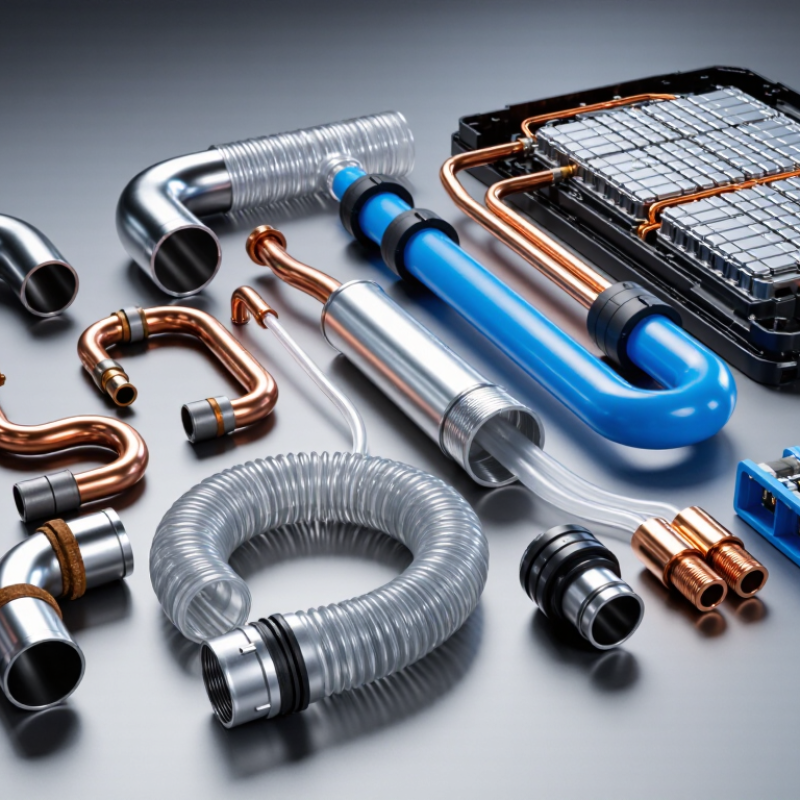
Battery liquid cooling pipes guide coolant through cells, modules, and heat exchangers. Their structure determines pressure loss, contact area, and service reliability. Common designs include straight tubes, U-shaped tubes, serpentine channels, parallel branches, manifolded pipes, plate-integrated channels, jacketed pipes, flexible hoses, microchannel tubes, and immersion-compatible circulation lines.
Each type suits a different battery layout. Straight tubes simplify assembly but may leave uneven temperature zones. Serpentine channels provide longer contact paths, although they can increase flow resistance. Manifolded systems distribute coolant across several modules, helping control temperature variation. Plate-integrated channels sit beneath or between cells, creating compact thermal contact. Flexible hoses absorb vibration, but their fittings need careful inspection.
Material selection affects safety and operating life. Aluminum transfers heat efficiently and keeps weight low. Stainless steel tolerates pressure and corrosion, but adds mass. Copper offers excellent conductivity, yet its cost and galvanic compatibility require attention. Multilayer polymer pipes can reduce weight and vibration noise. They must resist coolant chemicals, heat, pressure cycles, and permeation.
The operating principle is straightforward: a pump moves coolant through the pipe network, and the fluid absorbs heat from the battery surface. The warmed coolant releases heat through a radiator or chiller before returning. Flow rate, inlet temperature, wall thickness, and contact pressure all matter. In testing, a pipe can look sound while a connector slowly leaks. That assumption deserves checking. Thermal uniformity often matters more than peak cooling capacity.
Battery liquid cooling pipes differ in geometry, pressure behavior, and service demands. The ten useful categories are round, flat, serpentine, microchannel, multi-port, corrugated, spiral, manifold-integrated, plate-connected, and flexible hose designs. Round tubes tolerate pressure well and simplify inspection. Flat tubes save space beside prismatic cells. Serpentine paths spread coolant across long modules, but pressure loss can rise. Microchannel and multi-port tubes offer high surface area with compact packaging. Corrugated pipes absorb vibration and thermal movement. Spiral tubes support even flow around cylindrical assemblies. Manifold-integrated channels reduce fittings and possible leak points. Plate-connected and flexible hose designs help bridge tight installation zones.
In practical pack reviews, I examine wall thickness, bend radius, weld quality, and coolant compatibility. A pipe may look efficient on paper. It can fail after repeated expansion and contraction. Temperature mapping should confirm that cell edges do not develop cold or hot zones. Pressure-drop testing also matters, especially when several branches share one pump. I prefer traceable material certificates and documented burst, vibration, and leak tests. Small details matter. A rough bend can restrict flow. An oversized connector can add weight and create an awkward service point. I have found that the “best” type changes with cell shape, coolant, available space, and maintenance access. That judgment remains imperfect. Pilot testing should challenge the design before production approval.
| No. | Pipe Type | Typical Material | Construction | Key Features | Common Battery-Cooling Use | Typical Temperature Range* |
|---|---|---|---|---|---|---|
| 1 | Smooth EPDM Rubber Hose | EPDM elastomer with textile reinforcement | Flexible, smooth-bore hose | Excellent resistance to water-glycol coolants, ozone, weathering, and vibration; good flexibility and cost efficiency. | Battery packs, chillers, pumps, and vehicle cooling circuits | Approximately −40°C to +125°C |
| 2 | Silicone Coolant Hose | Silicone rubber with polyester or aramid reinforcement | Multi-layer flexible hose | Wide temperature capability, low-temperature flexibility, good aging resistance, and strong vibration tolerance. | High-temperature sections near battery modules, power electronics, and thermal plates | Approximately −50°C to +180°C |
| 3 | PA12 Nylon Tube | Plasticized or stabilized polyamide 12 | Rigid or semi-flexible extruded tube | Low weight, smooth internal surface, good abrasion resistance, and relatively low coolant permeability. | Compact battery packs, fixed routing, and fluid lines requiring low mass | Approximately −40°C to +100°C |
| 4 | PTFE-Lined Hose | PTFE inner liner with braided polymer or metal reinforcement | Low-friction, chemically resistant composite hose | Very high chemical resistance, low friction, low moisture absorption, and excellent cleanliness. | Specialized cooling loops, aggressive coolant formulations, and high-purity fluid circuits | Approximately −60°C to +200°C |
| 5 | Corrugated Stainless-Steel Hose | Stainless steel, often with an external braid | Annular or helical corrugated metal tube | High temperature and pressure capability, strong fire resistance, and improved flexibility compared with straight metal tubing. | Protected routing near hot components or areas exposed to mechanical hazards | Approximately −196°C to +400°C |
| 6 | Aluminum Tube | Drawn or extruded aluminum alloy | Rigid straight tube, bent tube, or formed manifold | Low density, good thermal conductivity, corrosion resistance with suitable coolant, and easy forming. | Battery cold plates, pack manifolds, and long fixed coolant runs | Approximately −40°C to +150°C |
| 7 | Copper Tube | Copper or copper alloy | Rigid tube, brazed tube assembly, or formed thermal passage | Very high thermal conductivity, good heat transfer, and reliable joining by brazing or soldering. | Stationary battery cooling equipment, compact heat exchangers, and high-heat-flux passages | Approximately −40°C to +150°C |
| 8 | Multilayer Thermoplastic Tube | Polyamide or polyethylene inner layer with barrier and reinforcement layers | Co-extruded, multi-layer construction | Balances flexibility, burst strength, coolant compatibility, low permeability, and electrical insulation. | Electric vehicle pack routing and systems requiring controlled fluid permeation | Approximately −40°C to +125°C |
| 9 | Microchannel Flat Tube | Aluminum alloy | Flat multi-port tube with multiple small flow channels | Large heat-transfer area, compact packaging, low material volume, and efficient heat exchange. | Integrated battery cold plates, evaporators, and compact thermal-management modules | Approximately −40°C to +120°C |
| 10 | Corrugated Polymer Hose | Corrugated PA, PE, or thermoplastic elastomer | Flexible bellows-style or convoluted tube | Small bending radius, vibration absorption, easy routing, and good protection against repeated movement. | Moving battery assemblies, service loops, hinged covers, and confined installation spaces | Approximately −40°C to +100°C |
*Temperature ranges are representative design ranges and depend on material grade, coolant composition, pressure, reinforcement, fittings, and installation conditions. Final selection should be verified against the applicable manufacturer specifications and safety requirements.
Top 10 Types of Battery Liquid Cooling Pipe: How Different Pipe Designs Manage Battery Heat
Battery liquid cooling pipes move heat away from cells through a controlled coolant circuit. Round tubes offer strong pressure resistance and simple manufacturing. Flattened tubes create broad contact with battery surfaces, improving heat transfer in tight spaces. Serpentine pipes spread cooling across long cell modules, though pressure loss can increase. Parallel pipes divide coolant flow, helping reduce temperature differences between distant cells. Microchannel designs use narrow passages and large wetted areas. They cool efficiently but may clog more easily.
Extruded aluminum channels provide rigid, uniform paths beside cell groups. Flexible polymer hoses absorb vibration and simplify installation around corners. Coiled pipes fit compact compartments, but bends can restrict flow. Dual-wall pipes add separation between coolant and electrical components. Cold-plate channels, often paired with battery trays, remove heat through a flat metal surface.
In practical testing, pipe spacing matters as much as pipe material. A two-millimeter gap can change contact resistance noticeably. Uneven clamping may leave hot spots near the module center. That issue is easy to miss.
Engineers should check flow rate, pressure drop, leak resistance, thermal expansion, and service access. A design that performs well in laboratory conditions may struggle after repeated vibration cycles. Coolant distribution also changes with vehicle angle and temperature. No pipe layout is perfect. Testing exposes weaknesses. Careful sensor placement reveals them.
How different pipe designs manage battery heat through coolant-contact area
The chart compares representative wetted perimeter per metre of active coolant path. Values are calculated from typical, non-branded cross-sections using geometric formulas. A larger wetted perimeter can provide more coolant-contact area, while actual heat removal also depends on coolant velocity, thermal resistance, pressure drop, material, and battery-pack contact quality.
Top 10 Types of Battery Liquid Cooling Pipe
Battery liquid cooling pipes balance heat transfer, durability, cost, and system compatibility. The main options include EPDM rubber, silicone, PA12 nylon, PTFE, PFA, TPU, aluminum, copper, stainless steel corrugated tubes, and multilayer thermoplastic pipes. EPDM is economical and flexible, while silicone tolerates wider temperatures. PA12 is lightweight and cost-efficient. PTFE and PFA resist aggressive coolants, but their higher prices and stiffness complicate routing. TPU offers strong abrasion resistance. However, coolant compatibility must be verified.
Metal pipes transfer heat effectively and resist mechanical damage. Copper performs well thermally, but its weight and galvanic corrosion risks require attention. Aluminum is lighter and cheaper, although vibration and joint fatigue remain concerns. Stainless steel corrugated tubing survives heat and pressure, yet it costs more. Multilayer designs combine barrier, reinforcement, and flexibility, but their fittings can be difficult to standardize.
The IEA’s Global EV Outlook 2024 reported nearly 14 million electric car sales in 2023, increasing demand for reliable thermal systems. NREL research commonly identifies approximately 20–40°C as a useful battery operating range, depending on chemistry and duty cycle. In practical testing, a pipe must survive pressure pulses, coolant aging, vibration, and repeated temperature cycling. A low-cost EPDM tube may outperform a premium fluoropolymer in a mild environment. That is easy to overlook. Engineers should recheck bend radius, permeation, connector materials, and service access before approving any design.
Top 10 Types of Battery Liquid Cooling Pipe
Selecting the right battery cooling pipe starts with the pack’s real operating conditions. Common options include copper, aluminum, stainless steel, polymer, multilayer, corrugated, flexible, extruded-channel, welded-plate, and microchannel pipes. Each type balances thermal transfer, weight, flexibility, corrosion resistance, and cost. Copper transfers heat efficiently, but it adds weight and may require electrical isolation. Aluminum is lighter, yet it needs careful protection against galvanic corrosion. Polymer pipes resist many coolants and reduce electrical risks. However, aging can become difficult to detect.
Check coolant chemistry, pressure, temperature range, bending radius, and vibration exposure. A pipe that fits perfectly on a workbench may fail after repeated thermal expansion. For compact packs, microchannel and extruded-channel designs offer strong cooling performance. Flexible hoses suit moving connections, but they need firm clamps and generous routing space. Never select by diameter alone.
Maintenance should include visual inspections, pressure-decay testing, and coolant sampling. Look for whitening, swelling, abrasion, loose fittings, and dried residue near joints. Small leaks often leave evidence before pressure drops noticeably. Replace damaged seals rather than tightening fittings repeatedly. Excessive tightening can deform the pipe.
Record temperatures at the inlet and outlet. A growing temperature difference may indicate blockage, air pockets, or pump problems. Thermal cycling tests are valuable, but they do not recreate every road vibration. That limitation deserves attention. Keep service records with coolant age, test pressure, and observed defects. In practice, the “best” pipe can still be wrong when installation space, maintenance access, or isolation requirements are overlooked.