
What Are the Top Types of Pool Water Testers?

Choosing a Pool Water Tester is less about buying the most advanced device and more about matching the test to the pool’s needs. The main options include color-matching test strips, liquid reagent kits, digital photometers, and electronic meters. Each checks different parameters, and convenience can come with trade-offs in precision, cost, and upkeep.

The public-health stakes are real. A CDC report recorded 493 outbreaks linked to treated recreational water venues in the United States from 2000 through 2014, with 27,219 illnesses and eight deaths. Those figures do not mean poor testing caused every outbreak. They do show why routine water checks matter. CDC guidance recommends keeping pool pH between 7.0 and 7.8 and maintaining appropriate disinfectant levels. A tester can help monitor those measures, but it cannot prove water is free from every health risk.

Strips are quick beside the pool, though reading subtle colors can be tricky in bright sunlight. Liquid kits offer a familiar visual comparison, while photometers measure color changes electronically and may provide more repeatable readings. Digital meters can target specific factors, such as pH or salt, but need calibration and care. A quick strip is useful, not magic. The right choice depends on which readings matter, how often they are taken, and whether users can follow the instructions consistently. Even experienced owners can misread a result; that small uncertainty deserves attention.
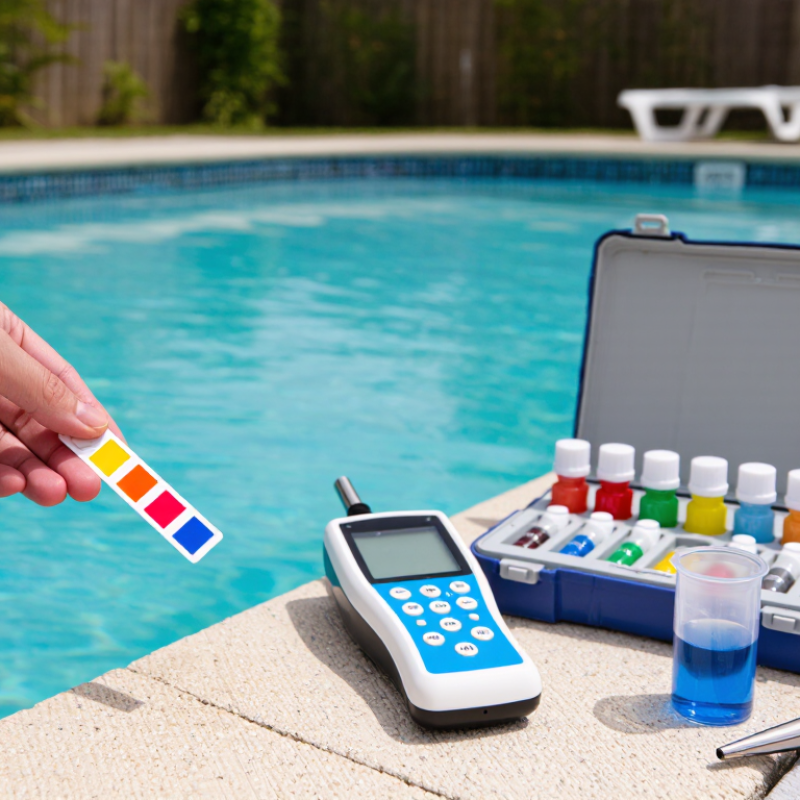
What Are the Top Types of Pool Water Testers?

How Pool Water Testers Measure Chemical Balance

Pool water testers estimate chemical balance by reacting a sample with indicators or sensors. Test strips contain pads that change color when exposed to water. Their shades correspond to ranges for pH, free chlorine, and sometimes alkalinity or stabilizer. Compare them with the chart under natural light, not beside a brightly colored pool towel. Color can deceive. Read the strip at the time stated in its instructions; waiting longer can distort the result.

Liquid reagent kits use measured drops in a clean vial. After mixing, the sample changes color, which you match to a scale. Digital photometers read how much light passes through a treated sample, giving a numerical result. Some meters use electrodes to measure pH directly, but they still need proper cleaning and calibration. A number is not automatically accurate.

Sample water from elbow depth, away from return jets and skimmers, where chemicals may be unevenly mixed. Test pH and sanitizer together: one can affect how well the other works. Alkalinity helps explain why pH keeps drifting, so a single pH reading may not tell the whole story. I have found timing easy to overlook; test soon after collecting the sample, and repeat a surprising result before making adjustments. Reagents age, strips absorb moisture, and small handling mistakes matter.

Test Strips for Fast, Routine Pool Checks

Test strips are a convenient choice for quick, routine pool checks. Dip one into a clean water sample, then compare its color pads with the chart. A quick dip. Many strips check chlorine and pH, while some also measure alkalinity or other water conditions. Check the package details before buying, since test panels vary. In everyday use, the tricky part is matching colors accurately. Read them in good light and follow the exact waiting time.

For a more dependable reading, take water from below the surface, away from return jets and skimmers. Avoid touching the pads, and close the container tightly after use. Heat and moisture can affect unused strips. Then compare each pad with the chart at the stated time, not several minutes later. Small timing differences matter.

Strips work well for spotting routine changes, but they are not a perfect answer to every water problem. If a result looks unusual, repeat the test with a fresh strip. Still uncertain? Confirm the reading with another test method or ask a pool-care professional. Keep a simple log of results and testing dates; patterns can be more useful than one isolated color match.

Pool Water Testers: Typical Time to Results

Test strips are a fast choice for routine checks, typically giving results in about 15–30 seconds. Liquid reagent kits and digital photometers commonly take around 1–3 minutes, depending on the test and instructions. Electronic probes can provide readings in under a minute, but usually measure specific properties rather than a full set of pool chemicals. Times are approximate and vary by product and procedure.

Liquid Reagent Kits for Detailed Water Analysis

Liquid reagent kits provide a hands-on way to check pool water beyond its appearance. Many kits measure free chlorine, pH, and total alkalinity, with some also testing calcium hardness or cyanuric acid. Take a sample below the surface, away from return jets, and fill the vial to its marked line. Rinse the vial with pool water before testing. Small details matter. Add the specified number of drops, holding the bottle upright when counting is required. Cap and mix gently, then compare the color with the chart in neutral daylight. Read it promptly.

These kits can offer useful detail, but they depend on careful handling and color judgment. A shade between two chart values can be hard to interpret; the reading is not perfectly objective. Check reagent expiration dates, keep caps matched to their bottles, and follow the kit’s instructions for each test. If a result seems surprising, repeat the test with a fresh sample before adjusting the water. Store reagents as directed, away from heat and direct sunlight. It is easy to rush this step, especially when the water looks clear, but clear water alone does not confirm balanced chemistry.

Digital Testers for Precise, Easy-to-Read Results

Digital pool testers convert a water sample into a number on a screen, making chlorine and pH readings easier to compare. Many use a small photometer: add the specified reagent, place the sample vial in the meter, and wait for the result. The display avoids judging subtle shades under changing sunlight. That helps when a pale pink test strip looks different beside a blue pool wall.

The CDC’s Healthy Swimming guidance recommends pool pH of 7.0–7.8 and at least 1 ppm free chlorine, or 2 ppm when cyanuric acid is used.

Those figures give readings practical context; they are not a reason to trust every screen blindly.

Rinse the vial, use fresh reagents, and follow the meter’s calibration instructions. Tiny handling errors matter. A fingerprint on the vial can affect a reading, and an old reagent may give false confidence. Digital results feel precise, but they still depend on careful sampling. I have found the display most useful for spotting a trend, not declaring the water perfect after one test. A second measurement can be worth the extra minute.

Continuous Sensors for Ongoing Water Monitoring

Continuous sensors track changing pool conditions between manual tests. A probe near a circulation return can report pH, oxidation-reduction potential, and water temperature throughout the day. These readings help reveal patterns, such as pH rising after a busy afternoon or shifting after rain. Small changes matter.

They do not make water maintenance automatic. ORP can indicate how effectively water is oxidizing contaminants, but it is not a direct measurement of free chlorine. Sensor readings can also drift when probes become dirty, poorly positioned, or overdue for calibration. Check the manufacturer’s instructions, clean the sensing surfaces as directed, and compare readings with a reliable test kit on a regular schedule. A cloudy display is not proof of a clear pool.

For useful monitoring, place sensors where water circulates steadily, rather than in a stagnant corner or directly beside a chemical feeder. Look for sustained trends, not a single unusual number. If a reading changes sharply, verify it before adjusting the water. I’ve found that even a well-maintained sensor can be fussy after heavy use or a storm. That is worth remembering: continuous data supports good judgment; it does not replace it.

What Are the Top Types of Pool Water Testers? - Continuous Sensors for Ongoing Water Monitoring
Sensor Type What It Measures Typical Pool Use Main Strength Important Consideration
pH Sensor How acidic or alkaline the water is, reported on the pH scale. Continuous tracking of pH in a pool circulation line or monitoring system. Helps identify changes that can affect swimmer comfort, sanitizer performance, and water balance. Requires routine calibration and cleaning. It does not measure sanitizer concentration.
Oxidation-Reduction Potential (ORP) Sensor The water’s oxidation-reduction potential, reported in millivolts. Ongoing indication of the water’s oxidizing conditions, often used alongside pH monitoring. Provides a continuous trend that can help operators spot changes in disinfection conditions. ORP is not a direct measurement of free chlorine. Readings are influenced by pH, temperature, and other water conditions.
Amperometric Chlorine Sensor Free chlorine or another specified chlorine parameter, depending on the sensor design. Continuous sanitizer monitoring in systems designed for the sensor’s chemistry and operating conditions. Measures a chlorine-related parameter directly rather than relying on ORP as a proxy. Sensor type, pH compensation, flow requirements, and maintenance needs vary. Confirm that the device is suitable for pool water.
Conductivity Sensor Water’s ability to conduct electrical current, which is related to dissolved ions. Monitoring changes in dissolved ionic content, especially in pools where salt or water balance is tracked. Can reveal broad changes in the water’s ionic content over time. Conductivity does not identify individual substances and is not a substitute for testing sanitizer, pH, or specific dissolved chemicals.
Temperature Sensor Water temperature. Continuous tracking of pool temperature and temperature changes that may affect water management. Simple, ongoing measurement that can provide useful context for interpreting other readings. Temperature alone does not indicate whether pool water is safe or properly sanitized.
Multi-Parameter Sensor System Two or more parameters, commonly selected from pH, ORP, chlorine, conductivity, and temperature. Centralized, ongoing monitoring where multiple water conditions need to be viewed together. Combines readings in one monitoring setup and makes it easier to review trends. Each measurement has its own accuracy, calibration, and maintenance requirements. Verify which parameters are directly measured.

Article Source: